


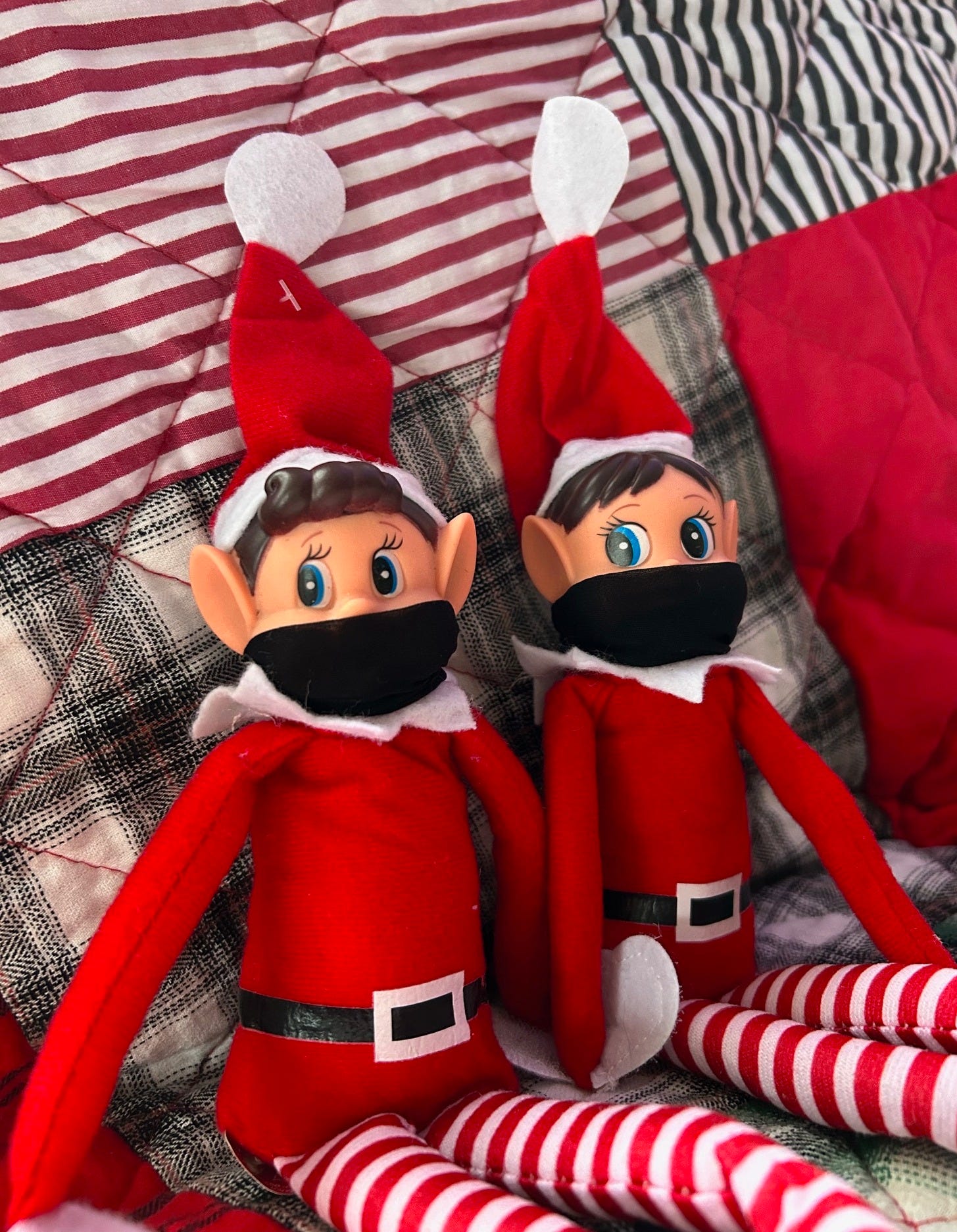
In 2005, a children’s book titled The Elf on the Shelf introduced its eponymous new Christmas character: a merry little Elf dispatched to the home by Santa Claus to monitor children in the lead-up to the big day. The Elf travels each night under the cover of darkness to the North Pole to brief the Big Man personally on the child’s day, their best moments, worst moments, most wanted gifts. At dawn, he returns to the home to hide until morning when the children awake and joyously hunt for him in a game of hide-and-seek. The book comes with a physical elf doll, which children are encouraged to name and parents encouraged to treat as real, the family compelled not to imagine a story but enact belief.
Over the following decade, this little-known picture book exploded into a full-blown phenomenon, a newfound 21st century tradition spawned by the swirling forces of social media and economic insecurity. Intoxicated by the promise of Pinterest and Facebook, reeling from the Great Recession, and starved for order, the American people searched for a story to help make sense of a chaotic, changing world. The Elf on the Shelf, leering, reached out from our laptops and grabbed us by the throat. Today, its humble creators are worth 100 million dollars.
The Elf on the Shelf is described as a scout—an undeniably martial term that signals the coming invasion, occupation, and finally annexation of the child’s inner life. At the behest of the Big Man, the elves are sent into the home, material reminders of his omniscience and our own impotence, lest we begin to question both. What we as children in our misbehaving moments imagine naively as a general goodwill and leniency on Santa’s part with regards to our conduct is eviscerated by the eagle-eyed Elf watching eagerly from the ceiling fan. He’s returning to the North Pole tonight, report in hand, detailing every last one of your transgressions. Mom might’ve not heard you muttering “stupid” under your breath when she asked you to bring your plate to the sink but he did and he’s gonna fucking bury you.
Behind enemy lines, the Elf operates without decorum and with impunity, afforded privileges and excesses denied to the child. He passes out in a pool of sugar on the kitchen counter, binges Netflix until sunrise, builds a pillow fort beside the bed from which to collect intelligence as your daughter dreams. Once sacred places for french toast breakfasts, family movie nights, and bedtime stories in which meaning was found in food, film, and fairy tale are thus contorted into sites of submission, an intrusion upon our most intimate spaces that is accepted, welcomed, and celebrated in the name of Christmas.
School is supposed to be a sanctuary but the elves are waiting there, too. Her classroom two, Romeo and Juliet, searched for each morning in a salivating frenzy. Romeo peers down from the whiteboard with a Christmas tree scrawled across it; Juliet somehow slips into Sarah’s backpack and tries to steal her snack. The elves remain for the entire day, unmoving, somehow even more unsettling than the principal slipping in mid-class and jotting notes quietly in the back. The child tries to focus on The Polar Express reading but can’t stop fixating on the elves. Did they see when he copied an answer off Katie’s paper, whispered a joke to Johnny, stared longingly at Sally and her mesmerizing curls? They can’t possibly see everything, the child reassures himself, but when he glances at the whiteboard he meets Romeo’s cold gaze.
Who is the Elf on the Shelf? Nobody knows for sure. Elves, ostensibly. Like the ones in Santa’s workshop, maybe just with more of an edge. They wear only red—their pants striped, hats pointed, cheeks fat and flushed. They carry no warrant and no identification, only the mandate of the season. Are they true believers who despise the naughty as we all should because they vie for gifts they did not earn? Are they strict devotees to the Big Man and the vision of a once-white Christmas to which he promises a return? Or are they simply morons too stupid to build a rocking horse who opted to stake out the bus stop in a blacked-out Cadillac instead? Their interrogators are inevitably met with the same frigid refrain: they work for Santa Claus.
If the Elf is touched he loses his magic—his aura of invincibility shattered by the brush of a fingertip. This is the one thing the child must never do. Drained of his life force, the Elf cannot make the nightly trip back to the North Pole, placing Christmas in jeopardy for the entire household. The official website puts forth only the possibility of an accidental touch, because intentionally touching the mystical, ogling being using your toothbrush is inconceivable in this universe. To challenge the elf is to embrace destitution.
Thus the giddy little boy who finds the Elf playing Xbox in the basement lurches from rapture to terror in an instant upon realizing that in his blind ecstasy he has gripped the grinning Elf in his fist. He flings it onto the couch like a risky text only to slowly bring his eyes up from the shadow on the floor. His big brother is standing over him, slack-jawed and wide-eyed. The little brother’s face goes hot as the Elf twitches violently on the couch; the tears begin to flow as he drops to his knees and begins to beg. It was an accident, he didn’t mean to, it was only for a second, the elf is okay, please don’t tell Mom, please, please, please don’t tell Mom—but his big brother is already sprinting up the stairs.
The Elf can be saved, of course. All the child has to do is repent. A heartfelt written apology to Santa or the stricken creature himself will do. Canonically, that’s the quickest way to get the magic back! Don’t ask questions. Don’t make excuses. Just admit wrongdoing, and you’ll still get the iPad. Children too young to compose a letter can perform an act of religious worship instead, and the whole family must take part, for the child’s sin extends to us all. We must sing a carol together because the elves love song and cheer. Surrounding the tree, singing “Santa Claus is Coming to Town”, the Elf rises again, nourished by the harmony of the very family he degrades.
The parent, as always, is complicit in this derangement, not a mere ideological ally but an active collaborator: hiding the Elf each morning, dishing out lore like crack, justifying its indiscretions time and time again. The most perverse parents post these acts of faith to their stories and reels, videos of them constructing toilet paper thrones and filling the kitchen sink with Swiss Miss, basking in the attention and validation brought on by this children’s book turned dick-measuring contest.
The kids are finally asleep and mom sits on the couch by the tree, pinot grigio in one hand and iPhone in the other. Drunk on wine and drunk on Christmas spirit, she adds an elf-sized baking sheet to her Amazon cart that will arrive just in time for breakfast, notifications still popping off from this morning’s post of the Elf riding the family’s chocolate lab. Upstairs, in bed, her daughter pulls her Frozen blanket up to her chin, wondering if the Elf has arrived at the North Pole, praying aloud for him not to tell Santa about the fight she had with her brother after school. She drifts off with more comforting thoughts of Christmas morning only to jolt upright two hours later when the tightly shut bedroom door creaks open. It’s just the wind, she tells herself, but when she falls back asleep she dreams of a boot on her throat.