


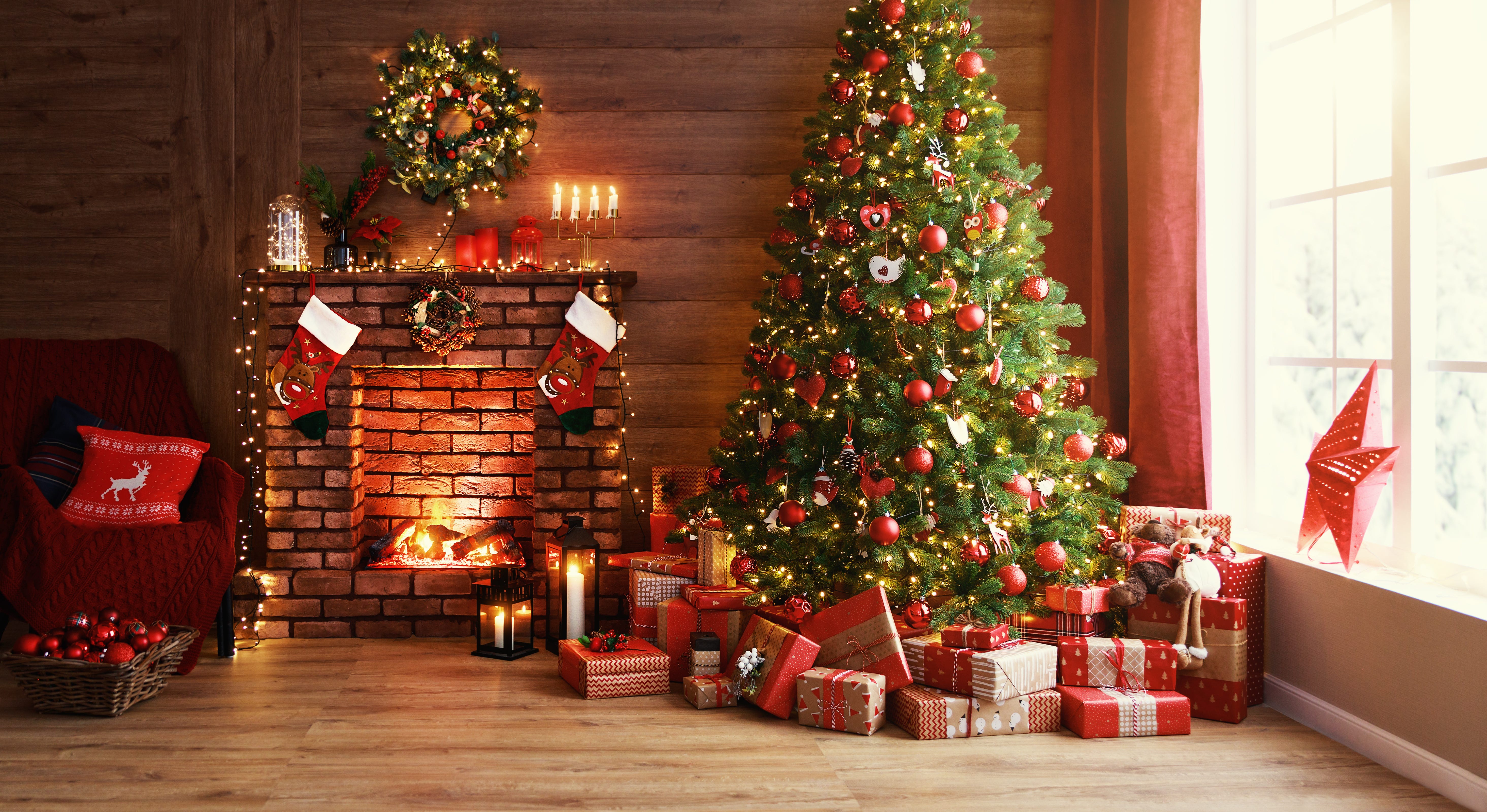
Walking my dog during the Christmas season can be a troubling task to say the least. Not because of the bitter New England cold that bites relentlessly at my nose, nor because of the garish seasonal lights which—though blinding—are simple tribal affirmations shouted across quiet streets. What shakes me to my core is the glamorous tree glittering in the corner window of every home—and the child basking in its intimate glow who cannot help but believe.
Sentimental, sexy, sacrosanct—the Christmas tree stands alone in its symbolism, the stunning centerpiece of the holiday home wherein belief in the Big Man and his all-consuming Naughty-Nice Binary is first proclaimed and then consummated. Its destruction joyous, its erection ritual, its worship sedative, and its bounty orgasmic, the terror the tree inflicts upon the human spirit is total.
No living thing in the history of the natural world has gotten shafted harder than the tree. Trees give and give and give and receive nothing in return. Oxygen, shade, apples, almonds, maple syrup—not to mention stability for our soil and shelter for our birds. Taller than us, older than us, wiser than us—strengthened, not weakened, by the passing decades—nothing stands in the way of profit like the tree. Just look at the once-lush Manhattan. Lucrative real estate deals have always been the driving force behind the American Dream—from the Louisiana Purchase to Manifest Destiny—and nothing impedes that divine mandate more than two-thousand acres of old-growth forest and an indigenous population that believes in its sublimity.
It doesn’t matter that none of us will ever cut a deal to turn a state park into a country club. Like our children, nephews, and nieces just a few days ago, we too sit at the Kids Table, awaiting our call up to the big leagues, mimicking the more powerful with every flick of the fork. The child swigs his apple cider just as Aunt Kay swigs her martini; you deride the tax code just like your CEO who makes your salary in an hour does, convinced that appetite and appetite alone will one day seat us beside them. And as they survey public lands to pick apart from their private jets, we hop into the Highlander and hit the Christmas Tree Farm, where the firs await their fate in solemn rows.
You approach one that’s slightly taller than the rest because you have high ceilings you’d like people to notice. You slap its hard bark, pull its taut branches, finger its fragrant needles. The family rules unanimously in its favor. A smiling staff member glides over, chainsaw in hand, and offers his congratulations. It will make a beautiful tree. He rips the cord one, two, three times and your heart flutters a bit as that gas-powered baby roars to life. You squeeze your daughter’s hand as its teeth cut violently into the trunk like a knife through cake, revealing the bone white bark beneath. The whole family claps and cheers when the tree, severed from its roots, slams into the cold dirt. The slaughtered tree is strapped tight atop the family SUV and hauled home, carried into the house as a casket, placed in the perfect corner spot by the window for the neighborhood to see. They must know that we are true believers. Draped in white lights, dressed in silver and gold garland, the corpse is resurrected for a second, electrified life.
Your parents pull out the overstuffed ornament box and unfold each newspaper-wrapped piece with precision, expounding upon each. The corporate intersperses with the personal until they become indistinguishable, memory and mass consumption amalgamating into one: First grade photos: your son, gap-toothed, in a Calvin Klein polo; Minnie Mouse Mrs. Claus straight from the Magic Kingdom; your once loyal lab licking your face from a Chewy paw print frame; a slick polar bear in a beach chair guzzling a glass Coke; two CVS reindeer rubbing antlers above the words “Our First Christmas”— celebrating not the union of two lovers but the marriage of household to shopping cart. At its top is placed a star, an angel, or—for the truly masochistic—a regal, rotund Santa adorned in the finest threads. Finally, the shrine is complete.
We stand before its glory, a painted canvas only our family could create. The ornaments doused in the soft light induce in you a deep longing and charged expectation, the purity of the past and promise of the future radiating hotly from this fabled false idol that once swayed in the wind but now stands still by the fireplace, infused with a religiosity it never requested, projecting a meaning it cannot comprehend.
Your child sprints to it each afternoon after school, switching it on, staring up stupefied, suffused with hope and wonder and magic as she speaks aloud to Santa, exclaiming that she answered three questions in class today and made her bed like mommy asked, reiterating her request for the Easy Bake Oven. You stare at it in the quiet of the morning, as the Folgers in the coffee pot gurgles and drips. In its shine you grasp briefly the optimism and excitement of the once-loved season but it fades with the rumble of your automatic start. Eight more days until December 23, you tell yourself as you step into the polar vortex, taking one last look through the window, and then a whole nine days to spend with your family.
From our reverence we receive deliverance: We awake on Christmas morning to presents piled high beneath the tree, prayers answered, anxieties laid to rest. Your children tear into the presents monstrously, frantically, incoherently—still stopping to scrap over the first rip of a shared gift, negotiating every last drop of dopamine as they’ve been trained to do.
Your son wants the PS5 more than anything in the world and he’s absolutely shameless about it. He actively searches for it, shakes each box, questions aloud if each present could be the present. Every gift he opens that isn’t a PS5 or supplementary controller, game, or headset is opened with an aura of disappointment that the ungrateful little shit barely tries to conceal and immediately tossed off to the side with the other half-acknowledged, thoughtful gifts. It’s actually gross.
But you and your smirking wife know your role. When the last gift beneath the tree has been torn open, she reaches behind the sofa and suddenly “finds” one last box in what is a final, fatal flourish. The son explodes in ecstasy—trembling, shaking, convulsing—tears in his eyes as he tears off a salacious strip of snowflake wrapping paper to reveal the sleek white box underneath. He plants a wet kiss on the box, prostrates himself on the carpet, and bellows his thanks up to the Big Man, birthed anew beneath the branches. The mother, relegated to midwife, beams. Rewarded by the Binary, the child is seized by it.
The Christmas tree trains us and the Christmas tree tortures us, a beacon to our own bondage we are too blind to see. We erect these spectral husks in our homes, offices, and squares. We pose in front of them, rock around them, ice skate under them. Our dogs sleep at their feet. We sing their praises, eat their frosted cakes, and marvel at their glimmering brilliance, never stopping to contemplate the uncompromising ethos of spiritual and ecological extraction that underpins their uncontested ubiquity. To question the tree is to question the chainsaw, and to question the chainsaw is blasphemy.